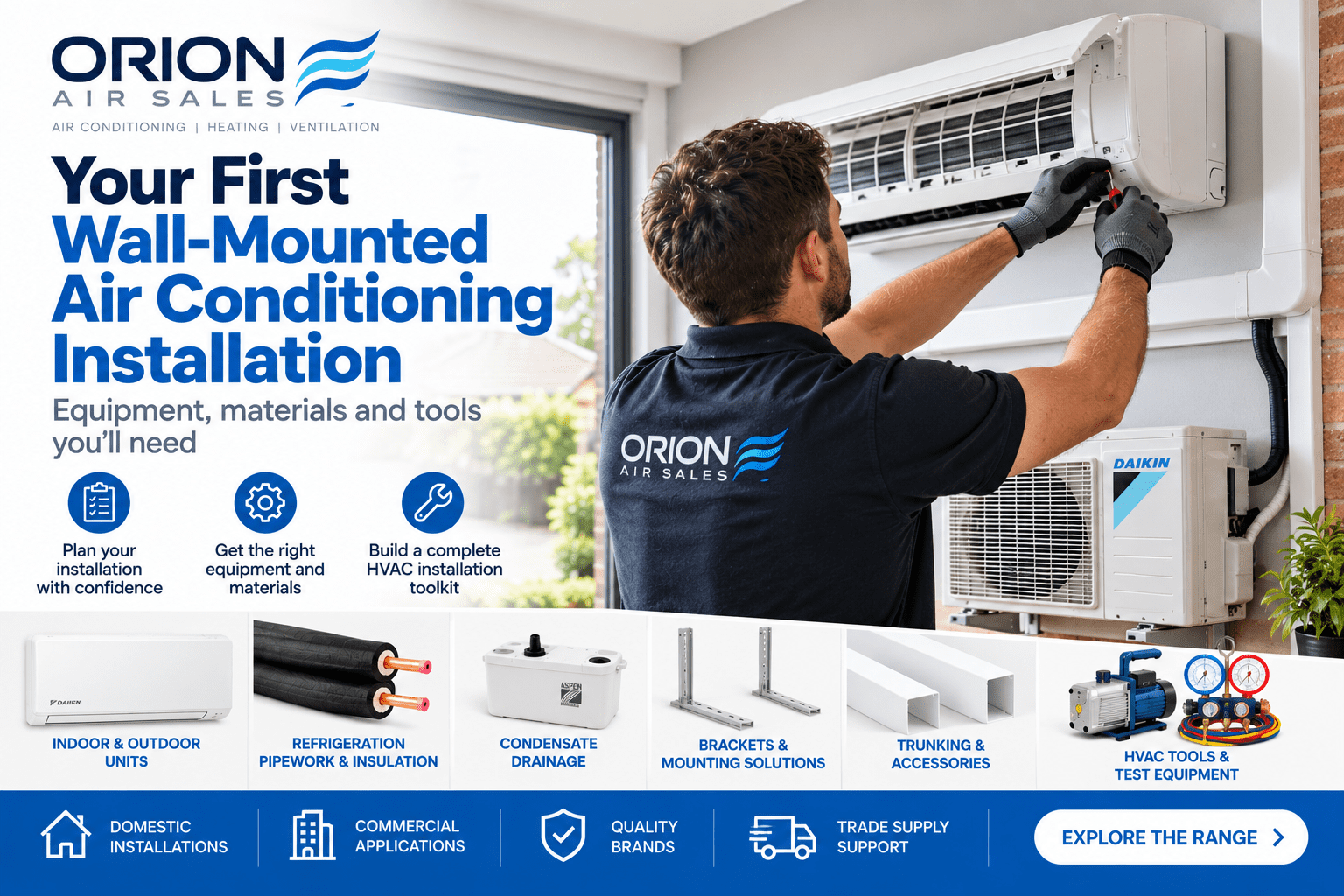
Moving into air conditioning can be a logical next step for plumbing, heating and building-services businesses, but the first wall-mounted split installation introduces equipment, materials and working practices that may be unfamiliar even to experienced tradespeople. A professional air-conditioning installation involves considerably more than mounting an indoor unit and connecting it to an outdoor condenser. Refrigeration pipework, condensate drainage, electrical connections, equipment positioning, pressure testing, evacuation, leak checking and commissioning all form part of the complete installation.
For engineers who are appropriately trained and qualified, understanding everything required before arriving on site can make installations considerably easier to plan. It also helps prevent a common problem when entering HVAC: concentrating on the air-conditioning system itself while overlooking the smaller components and specialist tools needed to complete the job. This guide looks at the equipment, materials and tools typically involved in a wall-mounted split air-conditioning installation and explains what each part contributes to the finished system.
What Is a Wall-Mounted Split Air-Conditioning System?
A wall-mounted split air-conditioning system normally consists of an indoor unit installed high on an internal wall and an outdoor unit positioned outside the building. The two sections are connected using refrigeration pipework along with the necessary electrical and control connections. Condensate produced by the indoor unit during cooling also needs to be safely drained away.
Many modern split air conditioners are reversible air-to-air heat pumps, meaning the same system can provide cooling during warmer weather and heating when temperatures fall. This makes wall-mounted systems suitable for applications ranging from bedrooms and home offices to shops, salons, treatment rooms and conventional offices.
What Do You Need to Install Wall-Mounted Air Conditioning?
The precise installation materials depend on the manufacturer, model, property and installation design, so there isn't a universal kit that suits every air-conditioning system. At a broad level, however, an installation normally requires the indoor and outdoor equipment, suitable refrigeration pipework, pipe insulation, condensate drainage, electrical and communication connections, outdoor-unit mounting equipment, trunking or containment where required, suitable fixings and specialist refrigeration tools.
It is important to check the installation manual before purchasing materials. Refrigeration pipe diameters, cable requirements, maximum pipe lengths, allowable height differences, drainage arrangements and electrical requirements can vary between systems. Professional installers should therefore build their material list around the actual equipment being installed rather than relying on assumptions from a previous job.
Start With the Correct Air-Conditioning System
Before thinking about copper pipe, brackets or tools, the correct air-conditioning system needs to be selected. Wall-mounted split systems are available in numerous capacities, commonly including nominal sizes around 2.5kW, 3.5kW, 5kW and larger, but capacity shouldn't be selected from room floor area alone.
Room dimensions are only one part of a cooling-load assessment. Glazing, orientation, insulation, occupancy, computers, lighting, other heat-producing equipment and the way the room is used can all affect the required capacity. A small office containing several computers and occupants, for example, can have a very different cooling requirement from an identically sized bedroom.
Indoor and Outdoor Units Must Be Compatible
With a conventional single-split installation, the indoor and outdoor units are designed to operate as a matched system. Installers should use compatible combinations specified by the manufacturer rather than treating indoor and outdoor equipment as interchangeable components.
Compatibility becomes even more important when moving into multi-split systems, where several indoor units may operate from one outdoor unit. Manufacturers specify permitted combinations, connected capacities, pipe lengths and other limitations. For an installer completing early HVAC projects, straightforward single-split systems can provide a useful foundation before progressing into more complicated multi-zone applications.
Refrigeration Copper Pipework
Refrigeration copper is one of the most important materials required for a split air-conditioning installation. The indoor and outdoor units are connected by two refrigerant lines, commonly referred to as the liquid and gas lines. The required pipe diameters are specified by the equipment manufacturer and must match the system being installed.
Heating and plumbing engineers entering HVAC should be particularly careful not to assume that ordinary plumbing copper can simply be substituted. Refrigeration pipework needs to be suitable for the intended refrigerant system and operating pressures, and cleanliness inside the refrigeration circuit is critical. The ends of the pipe should remain protected from contamination during storage and installation, and all preparation and joining procedures need to follow appropriate refrigeration practices.
Pre-Insulated Twin Copper Coil Can Simplify Installation
Pre-insulated twin copper coil combines the two refrigeration lines with suitable insulation, helping installers route both pipes together through a building. Products such as Freddox pre-insulated twin copper coil, available from Orion Air Sales, are designed specifically for air-conditioning and heat-pump applications and are supplied in several pipe-size combinations.
For installers coming from plumbing and heating, pre-insulated coil can make material preparation more straightforward because the refrigeration pipework and insulation are already combined. The correct pipe-size combination must still be selected for the particular air-conditioning system, and manufacturer requirements concerning pipe length, bends, connections and installation procedures continue to apply.
Why Is Refrigeration Pipe Insulation Important?
Refrigeration pipework operates at temperatures that can differ significantly from the surrounding air. Correct insulation helps manage unwanted heat transfer and can prevent condensation forming on cold pipe surfaces where applicable.
Damaged, incomplete or poorly fitted insulation can undermine an otherwise tidy installation. Joints and transitions therefore need appropriate attention rather than leaving sections of copper exposed. When routing pipework outside, installers should also consider how the insulation and pipework will be protected from weather, sunlight and physical damage.
Refrigeration Pipe Connections and Flaring
Many smaller split air-conditioning systems use flare connections between the refrigeration pipework and equipment. Producing a reliable flare requires suitable refrigeration-grade tools and correct preparation of the copper tube. The pipe needs to be cut cleanly, prepared correctly and flared according to the equipment and tool requirements.
Connections also need to be tightened according to the manufacturer's instructions, often using specified torque values. Simply tightening a flare connection until it feels right isn't a professional substitute for the correct procedure. This is one reason specialist HVAC training remains important even for engineers with substantial experience working with conventional copper plumbing.
Refrigeration Pipe Cutters and Deburring Tools
A suitable pipe cutter allows refrigeration copper to be cut cleanly without unnecessarily deforming the tube. After cutting, the pipe needs to be prepared correctly before a flare or other approved connection is made.
Care is particularly important when removing burrs because debris must not be allowed to enter the refrigeration circuit. Refrigeration systems are sensitive to contamination, so seemingly minor preparation steps can have an important effect on long-term system reliability.
What Is a Torque Wrench Used for in Air Conditioning?
Where the manufacturer specifies a tightening torque for refrigeration connections, a suitable torque wrench allows the installer to tighten the connection accurately. Different pipe sizes and equipment may require different values, so the installation documentation should always be consulted.
Overtightening isn't necessarily safer than undertightening. Either can create problems. Professional HVAC installation is about following the specified procedure rather than relying solely on previous experience or physical feel.
Outdoor Unit Wall Brackets
The outdoor condenser needs a stable, suitable mounting arrangement with adequate clearance for airflow and servicing. Where it is mounted to an external wall, appropriately selected air-conditioning wall brackets may be used.
Bracket selection needs to account for the outdoor unit's dimensions and weight as well as the structure to which the bracket is being attached. The finished installation must provide secure support while maintaining the manufacturer's required clearances around the equipment.
Ground Mounting Feet and Bases
Wall brackets aren't suitable for every property. Where an outdoor unit is installed at ground level or on an appropriate flat surface, mounting feet or a suitable base may be used instead.
Ground-level positioning can sometimes improve service access, but the installation still needs to protect the equipment from inappropriate conditions and maintain the manufacturer's airflow requirements. The condenser shouldn't simply be placed directly onto unsuitable ground without a proper mounting arrangement.
Anti-Vibration Mounts
Compressors and fans naturally create some vibration while operating. Suitable mounting arrangements can help prevent unnecessary vibration from being transmitted into the supporting structure.
This can be particularly relevant where outdoor units are mounted close to occupied rooms. Anti-vibration products don't compensate for poor equipment positioning or unsuitable structural support, but they can form part of a correctly designed mounting arrangement.
Condensate Drainage
When an indoor air-conditioning unit operates in cooling mode, moisture from the room air can condense on the indoor heat exchanger. This water collects within the unit and needs to be removed safely through a suitable condensate drainage system.
Where possible and permitted by the equipment design, gravity drainage can provide a simple solution. The drain needs to be routed correctly with an appropriate fall and discharge arrangement. Poorly designed condensate drainage can lead to water backing up into the unit or leaking into the customer's property, making this a part of the installation that deserves careful planning.
When Is a Condensate Pump Needed?
A condensate pump may be required where gravity drainage isn't practical. This can happen when the indoor unit's location doesn't allow the drain to maintain the required fall to a suitable discharge point.
Different pump designs suit different installations, so the pump needs to be selected according to factors such as the expected condensate load, lift and discharge requirements, installation arrangement and manufacturer instructions. A condensate pump shouldn't automatically be fitted simply because it appears easier than designing an effective gravity drain.
Condensate Pipe and Fittings
Condensate drainage requires appropriate pipework and fittings to create a reliable route from the indoor unit to the intended discharge point. The exact arrangement varies considerably between properties.
Plumbers and heating engineers moving into HVAC may find this aspect of installation relatively familiar, but air-conditioning condensate still has its own practical considerations. Pipe routing should be neat, adequately supported and designed to reduce the risk of restrictions, leaks and future maintenance problems.
Trunking and Pipework Containment
Refrigeration pipework, cables and condensate drainage frequently need to travel along internal or external walls. Purpose-designed air-conditioning trunking can provide a clean way of protecting and concealing these services.
Straight lengths can be combined with suitable bends, corners and other fittings to create a professional route between the indoor and outdoor equipment. Good trunking installation is partly functional and partly visual; customers will see it every day, so neatness can make a considerable difference to the perceived quality of the finished installation.
Wall Sleeves and Penetrations
A split-system installation normally requires a wall penetration through which refrigeration pipework, drainage and cables can pass. The position and angle of this penetration need to be planned around the indoor unit and the construction of the building.
Installers should consider what may be concealed within the wall before drilling and use suitable equipment for the particular construction. Once services have been installed, the penetration needs to be finished appropriately to help prevent water ingress, draughts and unwanted access by pests.
Electrical Supply and Interconnecting Cables
Split air-conditioning systems require electrical power as well as communication or interconnecting wiring between components. The precise electrical arrangement varies between manufacturers and models. Some systems are supplied through the outdoor unit, while others may use different configurations.
The manufacturer's electrical documentation should therefore be followed rather than assuming every system is wired in the same way. Cable type, conductor size, protective devices, isolation and other electrical requirements need to comply with the equipment instructions and applicable electrical requirements, with electrical work undertaken by appropriately competent persons.
Local Isolation
Suitable electrical isolation may be required so the equipment can be safely disconnected for maintenance and service work. The exact arrangement depends on the system, installation and applicable requirements.
This is another area where planning before arriving on site pays off. Discovering late in an installation that the necessary electrical components or cable aren't available can turn a straightforward job into an unnecessary second visit.
Vacuum Pump
A vacuum pump is one of the specialist tools associated with commissioning split air-conditioning systems. After the refrigeration pipework has been installed and appropriately tested, evacuation is used to remove air and moisture from the refrigeration circuit before commissioning in accordance with the manufacturer's procedure.
Using a vacuum pump shouldn't be treated as simply running it for an arbitrary number of minutes. Proper evacuation requires appropriate equipment, measurement and understanding of the process. Training is essential because moisture and non-condensable gases left inside the system can adversely affect operation and reliability.
Vacuum Gauge or Micron Gauge
A suitable vacuum measurement instrument allows an engineer to assess the evacuation of a refrigeration system rather than relying solely on elapsed time or the reading of a conventional pressure gauge.
The appropriate evacuation target and procedure should follow recognised practice and the relevant manufacturer's instructions. The important lesson for engineers entering HVAC is that time isn't a measurement of vacuum quality.
Refrigeration Manifold and Gauges
Refrigeration manifolds and suitable gauges are used in various diagnostic, commissioning and service procedures. Equipment must be appropriate for the refrigerant, pressure range and task being performed.
Engineers should receive proper training before interpreting refrigeration pressures because a gauge reading in isolation doesn't provide a complete diagnosis. Operating mode, ambient conditions, indoor conditions and system design can all influence readings.
Pressure Testing Equipment
Before commissioning, newly installed refrigeration pipework needs to be checked in accordance with the manufacturer's requirements and applicable professional procedures. This normally involves suitable pressure-testing equipment and the correct test medium.
Pressure testing isn't simply about proving that the system appears to hold pressure for a few moments. Appropriate test pressures, procedures and safety precautions need to be followed. These are skills that should form part of formal refrigeration training rather than being learned through trial and error on customer installations.
Leak-Detection Equipment
Leak prevention is fundamental to professional refrigeration work. Appropriate leak-detection methods and equipment can be required during installation, commissioning, servicing and fault finding.
The correct approach depends on the equipment, refrigerant and circumstances. Engineers should understand both the capabilities and limitations of the leak-detection methods they use rather than relying on a single technique for every situation.
Refrigerant Scales and Charging Equipment
Some installations and service procedures may require refrigerant quantities to be accurately measured. Suitable electronic scales allow refrigerant mass to be monitored where charging or recovery procedures require it.
New installers shouldn't assume that every new split system needs refrigerant added. Many systems are supplied with a factory charge intended to cover specified installation conditions, with manufacturer instructions explaining when additional refrigerant may be required. The correct procedure for the actual model should always be followed.
Refrigerant Recovery Equipment
Where work involves removing refrigerant from a system, appropriate recovery equipment and procedures are required. Refrigerant must not simply be released into the atmosphere.
This is an important distinction between fitting equipment and becoming a professional refrigeration engineer. Installers need to understand their responsibilities across the full life of the system, including servicing, repairs, refrigerant recovery and eventual decommissioning.
General Hand Tools Still Matter
Not every tool required for an air-conditioning installation is HVAC-specific. Installers also need a professional selection of general hand and power tools for mounting equipment, drilling penetrations, installing brackets, routing services and completing electrical or building work within the scope of their competence.
Experienced plumbers and heating engineers will already own many of these. The transition into HVAC therefore doesn't necessarily mean replacing an existing toolkit; it means adding the specialist refrigeration equipment needed to work correctly on air-conditioning and heat-pump systems.
Don't Forget Access Equipment and Site Safety
The indoor unit may be mounted high on a wall, while outdoor equipment can sometimes be positioned at height or in restricted areas. Suitable access equipment and safe working arrangements therefore need to form part of the installation plan.
A technically correct air-conditioning design doesn't justify an unsafe installation method. Where specialist access or working-at-height arrangements are required, these should be identified during the site survey rather than improvised once work has begun.
Survey the Property Before Ordering the Installation Materials
One of the easiest ways to avoid missing materials is to complete a proper site survey before ordering equipment. The survey should establish suitable positions for the indoor and outdoor units, an approximate pipe route, condensate strategy, electrical requirements, access requirements and the approximate lengths of the services needed.
It should also identify potential obstacles such as unusually thick walls, difficult external access, restricted condenser locations, long pipe routes or situations where a condensate pump may be necessary. A good survey turns the material list into a planned installation rather than a collection of guesses.
Think About Outdoor Unit Airflow
Outdoor units need adequate airflow to operate correctly. Installing a condenser inside an excessively enclosed area or too close to surrounding obstructions can interfere with airflow and make servicing difficult.
Manufacturer clearance requirements should be followed, but practical judgement matters as well. The unit needs to be accessible for future maintenance, and consideration should be given to neighbours, windows, boundaries and other parts of the property when selecting the position.
Think About Indoor Unit Airflow Too
Indoor-unit positioning affects how conditioned air is distributed through the room. A unit may technically fit on a wall while still being poorly positioned for airflow or maintenance access.
Furniture, curtains, tall cupboards and other obstructions can influence air distribution. The installation should also allow the indoor unit's filters and other serviceable components to be accessed without unnecessary difficulty.
Noise Should Be Considered During the Survey
Modern split air-conditioning systems can operate quietly, but equipment positioning still matters. An outdoor unit positioned immediately beside a bedroom window or attached to a structure prone to transmitting vibration can create avoidable problems.
Installers should consider the manufacturer's sound data, mounting method, operating conditions and surrounding environment. There is no single positioning rule that guarantees a silent installation, so the complete application needs to be assessed.
Commissioning the Air-Conditioning System
Once the physical installation has been completed, the system needs to be commissioned according to the manufacturer's instructions. This can include checking refrigeration connections, confirming the required test and evacuation procedures have been completed, checking electrical connections, verifying condensate drainage and testing the equipment in its operating modes.
The installer should also confirm that the indoor and outdoor units are operating correctly and that the customer understands basic controls and routine user maintenance such as filter cleaning where applicable. Commissioning is part of the installation, not an optional final step.
Keep Manufacturer Instructions With Every Installation
Even experienced installers shouldn't rely entirely on memory. Different manufacturers and product ranges can have different pipe sizes, charge allowances, maximum pipe lengths, electrical arrangements, clearance requirements and commissioning procedures.
Reading the technical documentation before starting can prevent expensive mistakes. For an engineer completing their first installations, it is particularly useful to review the manual during the planning stage rather than opening it for the first time after the equipment has already been mounted.
What Should Be on a First Air-Conditioning Installation Shopping List?
Rather than thinking of an installation as simply an indoor and outdoor unit, it is more useful to divide the job into several groups. There is the air-conditioning equipment itself, the refrigeration circuit, the condensate system, the electrical and control connections, the mounting and containment products, and finally the specialist installation and commissioning tools.
For a particular job, that might mean a correctly selected split system, the manufacturer's specified refrigeration copper sizes, appropriate insulation, condensate pipework or a pump, outdoor mounting equipment, trunking, suitable cables and fixings, together with the refrigeration tools required for pipe preparation, testing, evacuation, leak checking and commissioning. The exact list should always be produced from the site survey and manufacturer documentation.
Can Plumbers and Heating Engineers Install Their First System Themselves?
Existing plumbing or heating experience doesn't automatically authorise an engineer to undertake regulated refrigeration work. Engineers need the appropriate competence and qualifications for the activities they perform, and businesses working on applicable fluorinated-gas equipment must also consider current company certification requirements.
Anyone moving into HVAC should therefore arrange the appropriate training and verify the current UK requirements before undertaking customer installations. Regulations can change, so installers should refer to current official guidance rather than relying on an old article, forum discussion or previous industry practice.
Why Your First Installation Shouldn't Be Treated as a DIY Exercise
A wall-mounted split system can appear deceptively simple from the outside: one box indoors, one box outdoors and some pipework between them. The refrigeration circuit, however, introduces pressure, refrigerant handling, contamination control, evacuation, leak prevention and commissioning requirements that aren't visible once the finished installation is complete.
Professional installation is about what happens behind the trunking as much as what the customer sees. Correct training, correct tools and correct procedures protect the equipment, the installer, the customer and the environment.
Building a Repeatable Installation Kit
After completing several installations, HVAC contractors often develop a standard collection of commonly used materials and tools. Keeping frequently required items available can reduce wasted time and make installation preparation easier.
The important point is not to turn that standard kit into a substitute for planning. Pipe sizes, brackets, condensate requirements and electrical arrangements still vary. A repeatable installation process should make the contractor more organised, not encourage a one-size-fits-all approach.
Buying Air-Conditioning Equipment and Installation Materials From One Supplier
For heating engineers and plumbers entering HVAC, sourcing the complete installation can initially feel fragmented. The air-conditioning unit may be obvious, but refrigeration pipe, condensate products, mounting equipment, tools and installation accessories also need to be considered.
Using an established HVAC supplier can simplify procurement because the installer can source more of the equipment required for the complete job through one supply chain. This becomes increasingly useful as air conditioning changes from an occasional project into a regular part of the business.
Air-Conditioning Equipment and Installation Products From Orion Air Sales
Orion Air Sales supplies air-conditioning equipment alongside many of the products professional installers need to complete HVAC projects, including wall-mounted systems, refrigeration products, pre-insulated copper coil, condensate equipment, brackets, installation accessories and specialist HVAC equipment.
For plumbers and heating engineers expanding into air conditioning, this means the relationship with Orion can extend beyond simply purchasing the indoor and outdoor units. As the HVAC side of the business grows, installers can build a more consistent supply chain covering the systems and supporting materials required to get installations completed.
Your First Air-Conditioning Installation Is the Beginning of the Learning Process
Completing a first professional split-system installation is a significant step for an engineer entering HVAC, but it should be viewed as the beginning rather than the end of the learning process. Different properties, equipment types and system designs introduce new challenges, and experience needs to develop alongside continued technical training.
The strongest foundation is straightforward: obtain the correct qualifications, understand refrigeration principles, survey jobs properly, use appropriate materials and tools, follow manufacturer instructions and commission every system carefully. For an established plumbing or heating business, those principles can form the basis of a professional new HVAC service that develops progressively alongside the work the company already provides.
Frequently Asked Questions
What do I need to install a wall-mounted air conditioner?
A professional installation can require the indoor and outdoor units, correctly sized refrigeration pipework, insulation, condensate drainage, electrical and communication connections, mounting equipment, containment and fixings. Specialist refrigeration tools are also needed for pipe preparation, testing, evacuation, leak checking and commissioning.
What size copper pipe do I need for split air conditioning?
The required refrigeration pipe diameters depend on the specific system. Check the manufacturer's installation documentation rather than choosing pipe size from the nominal kW capacity alone.
Can I use normal plumbing copper for air conditioning?
You shouldn't automatically substitute general plumbing tube for specified refrigeration pipe. The pipework needs to be suitable for the refrigerant system, operating conditions and manufacturer's requirements.
Does refrigeration copper need insulation?
Refrigeration lines need to be insulated according to the system and manufacturer's requirements. Correct insulation helps control heat transfer and condensation where applicable.
What is pre-insulated twin copper coil?
It combines the two refrigeration copper lines with insulation, allowing them to be routed together. Products such as Freddox twin copper coil are designed for air-conditioning and heat-pump installations.
Does split air conditioning need a drain?
During cooling, moisture condenses at the indoor heat exchanger and needs to be removed through an appropriate condensate drainage arrangement.
Do I need a condensate pump?
Not necessarily. Where a suitable gravity drain can be achieved, a pump may not be needed. A condensate pump can be useful where gravity drainage isn't practical.
Do I need a vacuum pump to install air conditioning?
Correct evacuation of the refrigeration circuit is an important part of commissioning applicable split systems. Appropriate vacuum equipment and measurement should be used according to professional procedures and manufacturer instructions.
How long should you vacuum an air-conditioning system?
Evacuation shouldn't be judged solely by running a pump for an arbitrary amount of time. Appropriate measurement and the required procedure should be used to establish whether the system has been adequately evacuated.
Do I need a torque wrench for air-conditioning installation?
Where a manufacturer specifies connection torque values, an appropriate torque wrench allows connections to be tightened accurately according to those specifications.
Do new air conditioners need refrigerant added?
Not always. Many systems contain a factory refrigerant charge intended for defined installation conditions. Whether additional refrigerant is required depends on the model, pipe length and manufacturer's instructions.
Can a plumber install air conditioning?
Plumbing experience provides several transferable skills, but it doesn't automatically provide the qualifications required for regulated refrigeration work. Appropriate HVAC/refrigeration training and applicable certification are required.
Does an air-conditioning installer need F-Gas certification?
Where work involves applicable fluorinated refrigerants, current UK requirements concerning individual qualifications and company certification must be followed. Installers should check current official government and industry guidance before undertaking the work.
Can wall-mounted air conditioning provide heating?
Many modern split systems are reversible air-to-air heat pumps and can provide heating as well as cooling. Performance and operating limits depend on the particular equipment.
Can one air-conditioning unit cool several rooms?
A single indoor unit primarily conditions the area in which it is installed. It shouldn't automatically be assumed to provide effective temperature control across several separate rooms. Multi-split or other appropriately designed systems may be more suitable for multiple zones.
Where can installers buy air-conditioning equipment and installation materials?
Specialist HVAC suppliers such as Orion Air Sales can provide air-conditioning systems alongside refrigeration pipework, condensate equipment, mounting products, tools and installation accessories.