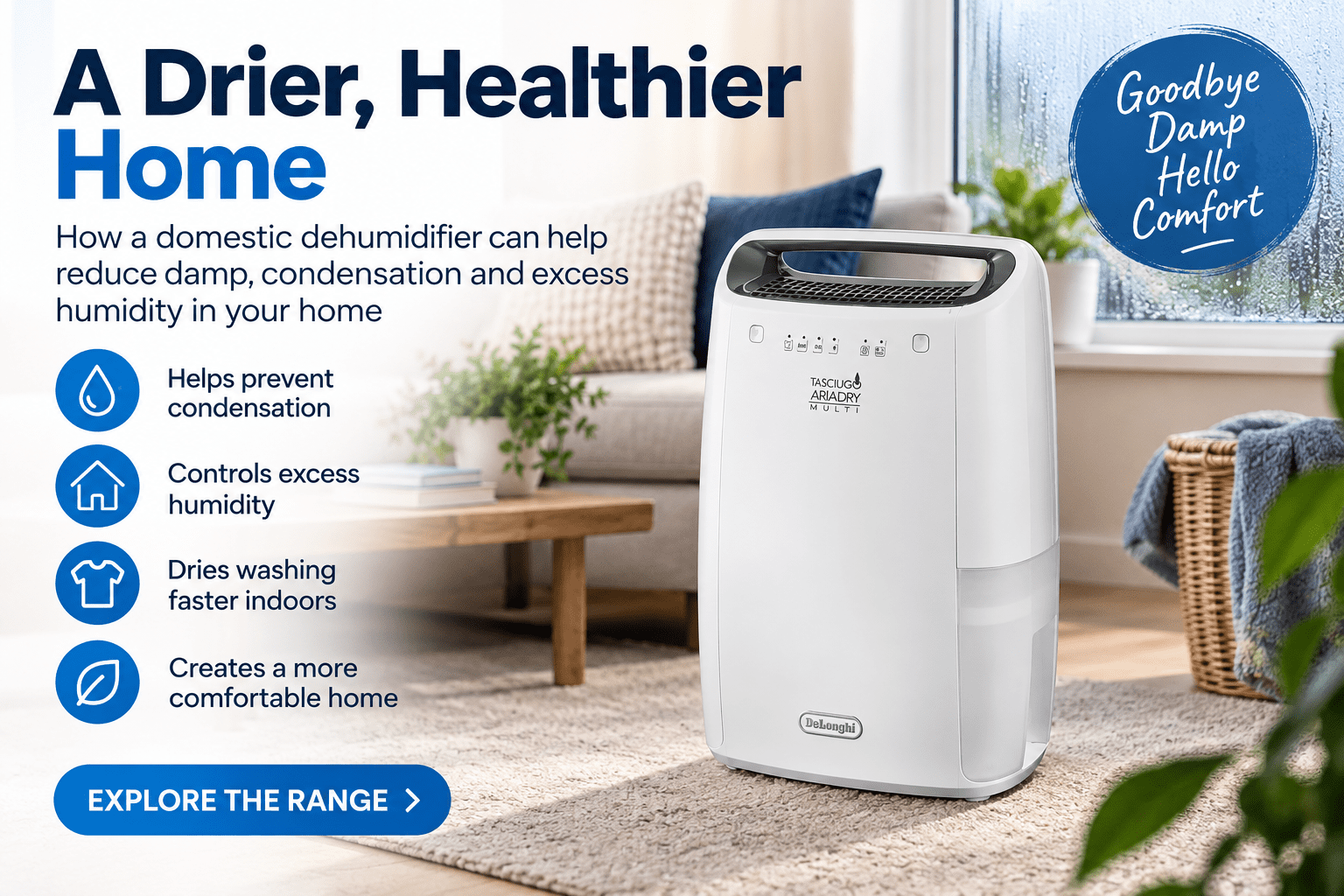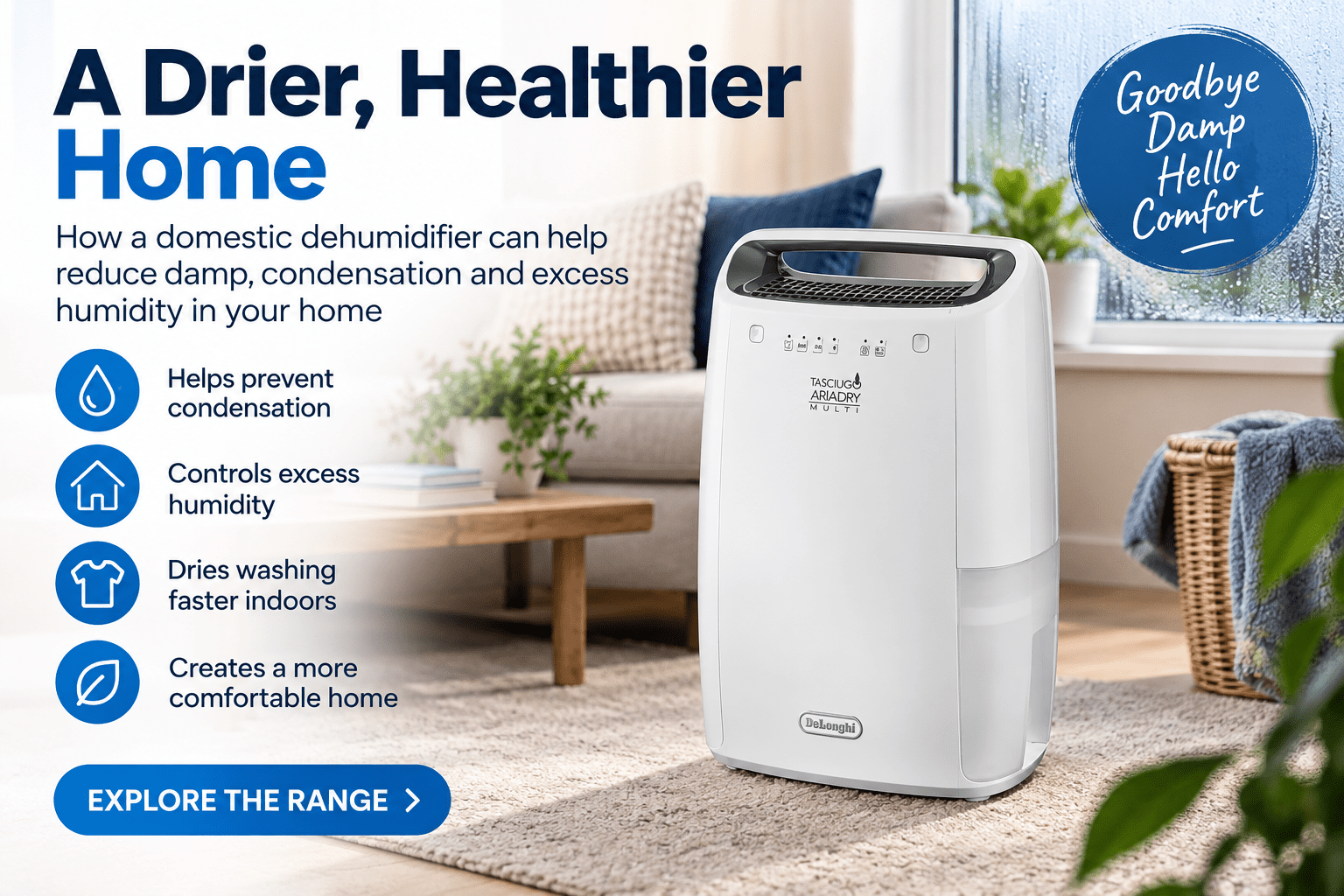
Excess moisture is a common problem in UK homes, particularly during the colder months when windows remain closed for longer, indoor temperatures vary and activities such as cooking, showering and drying laundry continually add water vapour to the air. The first signs are often condensation on windows, a persistent damp feeling or rooms that seem difficult to keep comfortable. Where excess humidity is contributing to these problems, a domestic dehumidifier can provide a practical way of removing moisture directly from the indoor air.
The Domestic Dehumidifiers range at Orion Air Sales includes compact moisture-control products through to portable compressor and desiccant dehumidifiers with published extraction capacities ranging up to 25 litres per day. The current range includes products from Meaco, DLUX, Prem-I-Air, Sealey and other manufacturers, with options suitable for homes as well as garages, workshops, caravans, boats and certain light-commercial applications.
What Does a Domestic Dehumidifier Do?
A domestic dehumidifier removes excess water vapour from the surrounding air. With a typical refrigerant or compressor dehumidifier, humid room air is drawn into the appliance and passed across a cold surface. Moisture condenses into water, which is collected in an internal tank or, on compatible models, removed through a continuous drainage arrangement. The drier air is then returned to the room.
The purpose isn't to make a home excessively dry. A dehumidifier provides a way of managing unwanted moisture when indoor humidity is higher than desired. Models with automatic humidity controls can cycle their dehumidification operation according to measured conditions, reducing the need for the appliance to extract moisture continuously once the selected conditions have been reached.
Why Do UK Homes Suffer From Condensation?
Everyday household activities introduce moisture into the air. Showering, bathing, cooking, boiling water and drying wet clothes indoors can all increase the amount of water vapour present. Occupants themselves also contribute moisture through normal respiration. If that moisture isn't adequately removed, indoor humidity can rise.
Problems become particularly noticeable when moist indoor air encounters colder surfaces. Windows are an obvious example, which is why droplets running down glazing can be one of the first visible indications of a moisture problem. External walls, corners and other colder surfaces can also be affected, particularly where ventilation, heating or the building fabric creates unfavourable conditions.
Can a Dehumidifier Help With Window Condensation?
A dehumidifier can help where condensation is associated with excessive indoor humidity because it removes water from the air before that moisture has the opportunity to condense onto sufficiently cold surfaces. Orion specifically lists keeping condensation off windows among the applications for its domestic dehumidifier range.
However, persistent condensation shouldn't automatically be blamed entirely on humidity. Poor ventilation, very cold surfaces, insulation problems and other building issues may also contribute. A dehumidifier can be an effective part of the solution, but identifying why moisture is accumulating is particularly important where condensation is severe or repeatedly returns.
Can a Dehumidifier Help With Damp?
This depends on what is causing the damp. If the problem is associated with excess moisture in the indoor air, lowering humidity can help create a drier environment. This is different from claiming that a portable dehumidifier can repair every form of damp within a building.
Water ingress, plumbing leaks and problems with the building fabric need their underlying causes addressed. A dehumidifier can remove moisture from the air, but it cannot repair a leaking pipe, roof or defective building component. Making that distinction is important when deciding whether domestic dehumidification is the appropriate solution.
Dehumidifiers and Mould: What Is the Connection?
Persistent high humidity and condensation can create conditions in which mould is more likely to develop. Controlling excessive indoor moisture can therefore form part of a wider strategy for reducing condensation and maintaining a drier indoor environment.
Existing mould still requires appropriate treatment, and the underlying moisture source should be investigated. Simply placing a dehumidifier in a room without addressing a leak or serious ventilation problem isn't a complete solution. The goal should be to understand the moisture source and then use ventilation, heating, dehumidification or building repairs as appropriate.
Using a Dehumidifier to Dry Washing Indoors
Drying laundry indoors transfers a surprising amount of water into the surrounding air. The water hasn't disappeared from the clothes; it has evaporated into the room. In a poorly ventilated home this can contribute to higher humidity and condensation elsewhere.
A domestic dehumidifier can remove some of this moisture while washing dries, and Orion lists drying washing as one of the uses for its domestic range. Some dehumidifiers also provide dedicated laundry operating modes, although features vary between models and should be checked before purchase.
Where Should You Put a Dehumidifier When Drying Clothes?
For indoor laundry drying, placing the dehumidifier in the room containing the washing allows it to work on the moisture being released. Follow the manufacturer's requirements regarding clearance around the air inlet and outlet rather than pushing the appliance against furniture or obstructing its airflow.
Keeping the laundry in a defined room can also prevent moisture from spreading unnecessarily throughout the rest of the property. Doors, windows and ventilation should be managed according to the appliance instructions and the wider ventilation needs of the home.
What Size Dehumidifier Do I Need?
Domestic dehumidifiers are frequently described using an extraction capacity such as 10L/day, 12L/day, 20L/day or 25L/day. This is useful for comparing appliances, but it shouldn't be interpreted as a guarantee that the machine will collect exactly that quantity of water every day in your home.
Extraction figures are measured under specified temperature and relative-humidity conditions, and actual water removal varies as those conditions change. For example, Orion's Prem-I-Air 12L model states its 12 litre/day extraction rating at 30°C and 80% relative humidity. In a cooler or less humid home, actual extraction can therefore be different.
Understanding Litres Per Day on a Dehumidifier
A 20 litre/day dehumidifier doesn't mean that it has a 20-litre water tank. The litres-per-day figure refers to its stated moisture extraction capacity under defined test conditions, while tank capacity is a separate specification.
This distinction is easy to miss. Orion's current range, for example, includes a DLUX 20 litre/day model with a 6-litre water tank, while other appliances combine different extraction and tank capacities. A smaller tank simply needs emptying more frequently unless the appliance provides a suitable continuous drainage arrangement.
Small Dehumidifiers for Localised Moisture Problems
Not every application requires a high-capacity machine. Orion's range starts with small moisture-control products and compact dehumidifiers, including the Prem-I-Air EH1210 with a stated 350ml/day capacity and the compact Ola EH1572 with a 0.38L moisture-removal rating and 1.5L tank.
These compact products occupy a very different part of the market from 12, 20 or 25 litre/day portable machines. They can make sense for smaller or more localised applications, whereas a significant household moisture problem generally warrants looking at equipment with a capacity appropriate to the amount of moisture and area being treated.
12 Litre Domestic Dehumidifiers
A 12 litre/day model can provide a useful step into full portable domestic dehumidification. Orion currently lists both the DLUX DLUX-12 and Meaco 12L ABC within this capacity range. The category also includes compact Prem-I-Air equipment with a published 12 litre/day extraction capacity.
The Prem-I-Air 12L model illustrates some of the features worth looking for. Its published specification includes electronic controls, automatic defrost, automatic restart after a power interruption, a washable filter, tank-full indication, carrying handles and castors. These are practical features when a dehumidifier is likely to move between rooms.
20 Litre Domestic Dehumidifiers
For larger homes or more demanding moisture loads, Orion's range contains several 20 litre/day options. These currently include the DLUX DLUX-20, Meaco 20L Medium Portable Dehumidifier, Sealey SDH20 and MeacoDry Arete One 20L.
A higher published extraction capacity can provide more moisture-removal capability under the specified rating conditions, but capacity still needs to be considered alongside room temperature, humidity, noise, controls, tank arrangement, drainage and how the machine will actually be used. Choosing solely from the largest number on the product title misses many of the factors that affect everyday ownership.
25 Litre Domestic Dehumidifiers
Orion's domestic range currently extends to 25 litre/day appliances including the Meaco 25L Low Energy Portable Dehumidifier and MeacoDry Arete One 25L Dehumidifier Air Purifier. These models provide another option where greater moisture extraction is required.
Larger-capacity domestic machines can be particularly useful where one appliance is intended to manage moisture across a larger part of a home or where the moisture load is substantial. Correct positioning and airflow between areas remain important; simply purchasing a higher-capacity appliance doesn't guarantee uniform humidity throughout a property with closed rooms and restricted air movement.
Compressor vs Desiccant Dehumidifiers
One of the most useful distinctions when choosing a dehumidifier is between compressor/refrigerant and desiccant technology. A compressor dehumidifier uses refrigeration principles to cool air below its dew point so moisture condenses. This technology is widely used for general domestic humidity control.
A desiccant dehumidifier uses a moisture-absorbing material rather than relying on condensation across a conventional refrigerated coil in the same way. Orion's current domestic range includes desiccant options such as the DD122FW Classic MK5 and Meaco DD8L Zambezi, alongside its compressor-based domestic products.
When Should You Consider a Desiccant Dehumidifier?
Temperature is an important consideration. Desiccant technology can be attractive for cooler environments where the characteristics of a conventional compressor dehumidifier may be less suitable. This can make desiccant units worth considering for particular cooler rooms and applications.
That doesn't mean desiccant technology is automatically the better choice for every home. Room temperature, required extraction, energy use, noise, application and purchase cost should all be considered. The best technology depends on the environment in which the appliance will actually operate.
Domestic Dehumidifiers for Bedrooms
A bedroom can develop excess moisture through occupancy, restricted ventilation and colder overnight conditions. Condensation may become particularly noticeable on bedroom windows during winter mornings.
For bedroom use, extraction capacity is only one consideration. Noise level becomes especially important if the dehumidifier will operate while the room is occupied or around sleeping hours. Controls, display brightness and the ability to maintain a target humidity automatically can also affect how convenient the appliance is in everyday use.
Dehumidifiers for Bathrooms
Bathrooms generate considerable amounts of water vapour from showers and baths. Appropriate extraction ventilation should normally be the first line of defence, but dehumidification may provide additional moisture management where humidity remains problematic.
Electrical safety is especially important around wet areas. Don't assume that an ordinary portable electrical appliance can be positioned anywhere in a bathroom. The manufacturer's installation and safety requirements must be followed, and the equipment needs to be appropriate for the proposed location.
Dehumidifiers for Kitchens
Cooking, boiling water and washing can all increase kitchen humidity. Extract ventilation can remove moisture at source, while a dehumidifier may assist with wider household humidity where moisture migrates beyond the kitchen.
A dehumidifier shouldn't replace a correctly functioning cooker hood or ventilation system where one is required. Instead, consider the technologies complementary: extraction removes moisture and pollutants close to their source, while dehumidification can reduce excess water vapour already present in the indoor air.
Dehumidifiers for Garages and Workshops
Garages and workshops can experience very different conditions from heated living areas. Lower temperatures, changing outdoor conditions and limited heating can all affect humidity and condensation.
Orion lists garages and workshops among the applications for some of its compact domestic equipment, including its Prem-I-Air 12L model. Temperature should be checked against the dehumidifier's specified operating range before purchase, particularly for an unheated garage during winter.
Dehumidifiers for Caravans and Boats
Caravans and boats can be particularly vulnerable to stale, damp conditions when closed for extended periods. Their relatively small internal volumes can make moisture management important during storage as well as periods of use.
Some Orion domestic models are specifically described for caravans and boats. Again, environmental temperature and the availability of safe drainage need consideration, particularly if equipment will be expected to operate for extended periods without regular supervision.
Using a Dehumidifier in an Office
Although described as domestic dehumidifiers, some products in Orion's range can also be suitable for offices and light-commercial environments. Small offices can experience humidity problems for many of the same reasons as homes, including occupancy, limited ventilation and the characteristics of the building itself. Orion explicitly includes offices and light-commercial applications within the category description.
The distinction between domestic/light-commercial and genuinely industrial dehumidification is important. A small portable unit shouldn't be expected to perform the same role as equipment designed for demanding manufacturing, construction or continuous industrial moisture-control applications. Orion maintains separate industrial/scientific and heavy-duty categories for these requirements.
Continuous Drainage vs Water Tank Collection
Most portable domestic dehumidifiers collect condensed water in an internal tank. Once that tank becomes full, it needs emptying, and appropriately designed units normally stop extraction until the tank has been emptied and replaced.
Some models can instead support continuous drainage, allowing collected condensate to leave through a hose or pump arrangement. Orion also lists a MeacoDry Arete pump accessory for compatible 20L and 25L models. Continuous drainage can be particularly useful when a dehumidifier needs to operate for longer periods without frequent manual emptying.
Dehumidifiers With Air Purification
Some modern dehumidifiers combine moisture removal with additional air-filtration features. Orion currently lists the MeacoDry Arete One 20L and 25L as dehumidifier/air-purifier products, alongside replacement H13 HEPA filters for compatible models.
It is important not to confuse the two functions. Dehumidification controls moisture; filtration removes certain airborne particles according to the filter and appliance design. A combined appliance can offer both functions, but reducing humidity isn't itself the same process as filtering particulate matter from the air.
How Much Water Should a Dehumidifier Collect?
There isn't one correct amount. Water collection depends on the starting relative humidity, temperature, moisture entering the space, appliance capacity and operating time. A dehumidifier may initially collect considerable amounts of water in a damp environment and then collect less as conditions become drier.
This reduction doesn't necessarily mean the machine has stopped working properly. If the environment is approaching the selected humidity level, there is simply less excess moisture for the appliance to remove. Automatic humidity control is useful because it allows compatible equipment to respond to changing conditions rather than operating at maximum extraction continuously.
Where Is the Best Place to Put a Dehumidifier?
Position the appliance where it has adequate airflow and where moisture needs to be controlled, while following the manufacturer's specified clearances. Blocking the air inlet or outlet can reduce performance.
If one dehumidifier is being used to influence several rooms, open internal doors may help air move between those areas where appropriate. However, individual house layouts vary considerably. A single appliance in a hallway shouldn't automatically be expected to control every closed bedroom equally.
Should Windows Be Open When Using a Dehumidifier?
If outdoor air is continually entering the space, the dehumidifier may have to process additional moisture rather than simply reducing the humidity within the intended area. For straightforward dehumidification, the manufacturer's operating instructions should be followed regarding doors and windows.
This shouldn't be interpreted as advice to permanently eliminate ventilation. Ventilation and dehumidification perform different jobs. Homes still require appropriate ventilation for indoor air quality and moisture management; a portable dehumidifier isn't a substitute for all ventilation.
Dehumidifier or Tumble Dryer for Laundry?
These appliances solve the laundry problem differently. A tumble dryer removes moisture directly from clothing inside the machine, while a dehumidifier removes moisture from the surrounding room air as wet laundry dries.
For households that already air-dry clothing indoors, a dehumidifier can therefore help manage the moisture released into the room. Which approach is preferable depends on the household, clothing, available space and equipment already installed.
Dehumidifier or Air Purifier?
A dehumidifier primarily controls moisture, whereas an air purifier primarily targets airborne contaminants through its filtration or treatment system. Someone with wet windows and excessive humidity therefore has a different problem from someone primarily interested in airborne particulate filtration.
Combined products can provide both capabilities. Orion's current MeacoDry Arete One products are examples of dehumidifiers that incorporate air-purification functionality, which can make a combined appliance attractive where both functions are wanted.
Domestic vs Commercial Dehumidifiers
A domestic dehumidifier is generally designed around homes and lighter-duty applications where portability, straightforward controls, manageable noise and convenience are important. Commercial and industrial environments can demand much greater airflow, more robust construction and different operating characteristics.
This distinction becomes especially important for flood restoration and structural drying. Orion's guidance specifically separates domestic comfort damp-control equipment from heavy-duty dehumidifiers intended for demanding restoration work. A household dehumidifier shouldn't automatically be selected for professional structural drying simply because its litres-per-day figure appears sufficient.
Choosing a Domestic Dehumidifier by Application
| Application | What to Consider |
|---|---|
| Bedroom | Noise, controls, extraction capacity and portability |
| Living Room | Room size, humidity level and automatic control |
| Laundry Room | Moisture extraction and laundry operating features |
| Bathroom | Humidity load, ventilation and electrical suitability |
| Kitchen | Ventilation, moisture generation and room conditions |
| Garage | Low temperatures and operating temperature range |
| Workshop | Moisture load, temperature and portability |
| Caravan | Compact dimensions and temperature |
| Boat | Space, drainage and operating environment |
| Home Office | Noise, humidity control and portability |
| Larger Home | Higher extraction capacity and airflow between rooms |
| Light Commercial Area | Duty, room conditions and required capacity |
How to Choose the Right Domestic Dehumidifier
Start by identifying the problem you're actually trying to solve. Is it condensation on bedroom windows? Laundry drying? General high humidity across several rooms? A cold garage? A caravan? These applications can point towards different capacities and technologies.
Then compare extraction capacity, operating temperature, noise level, tank capacity, continuous drainage, humidistat/control features, physical dimensions and portability. If the room is relatively cool, compare compressor and desiccant technology rather than choosing solely from the litres-per-day figure.
Domestic Dehumidifiers From Orion Air Sales
The Orion Air Sales domestic dehumidifier collection currently spans small moisture absorbers and compact units through to 12L, 20L and 25L/day portable dehumidifiers, as well as desiccant machines, combined dehumidifier/air-purifier products and compatible drainage and filtration accessories.
That breadth makes it possible to choose equipment around the actual moisture problem rather than treating every damp environment in the same way. For a home suffering from condensation, a laundry room producing large amounts of moisture or a cooler garage requiring humidity management, the important thing is matching the technology, extraction capacity and operating characteristics to the application.
Frequently Asked Questions About Domestic Dehumidifiers
What does a dehumidifier do?
A dehumidifier removes excess moisture from indoor air and collects or drains the resulting water.
Will a dehumidifier stop condensation on windows?
It can reduce condensation where excessive indoor humidity is contributing to the problem. Persistent condensation may also involve ventilation, insulation or other building factors.
Can a dehumidifier help with mould?
Reducing excessive humidity can help make conditions less favourable for moisture-related mould growth, but existing mould and its underlying moisture source still need appropriate attention.
What size dehumidifier do I need?
Consider the area being treated, temperature, humidity, moisture load and intended use rather than choosing from litres-per-day alone.
What does 20 litres per day mean?
It is a rated extraction capacity under specified test conditions. It doesn't mean the appliance contains a 20-litre tank or will collect exactly 20 litres every day in every home.
Is a 20L dehumidifier better than a 12L dehumidifier?
Not automatically. A 20L model has a higher rated extraction capacity, but suitability also depends on room conditions, noise, controls, operating temperature and application.
What is the difference between a compressor and desiccant dehumidifier?
A compressor model condenses moisture using a refrigeration process, whereas a desiccant model uses a moisture-absorbing material. Their performance characteristics differ, particularly as temperatures change.
Can I use a dehumidifier to dry clothes?
Yes. A dehumidifier can remove moisture released into the room while laundry dries, and Orion specifically lists drying washing among the uses for its domestic range.
Can I use a domestic dehumidifier in a garage?
Some models are suitable for garages, but check the manufacturer's specified operating-temperature range because garages can become considerably colder than occupied rooms.
Can I leave a dehumidifier draining continuously?
Compatible models can support continuous drainage arrangements. Installation and operation should follow the manufacturer's instructions.
Does a dehumidifier purify the air?
Not necessarily. Dehumidification and air purification are separate processes, although some products combine both functions.
Can one dehumidifier work for an entire house?
Potentially it can influence humidity across several connected areas, but performance depends on house size, layout, airflow, doors and moisture load. One machine shouldn't automatically be assumed to control every closed room equally.
Should I buy a domestic dehumidifier for flood restoration?
For significant structural drying, purpose-designed building or restoration equipment is generally more appropriate than a domestic comfort dehumidifier.