
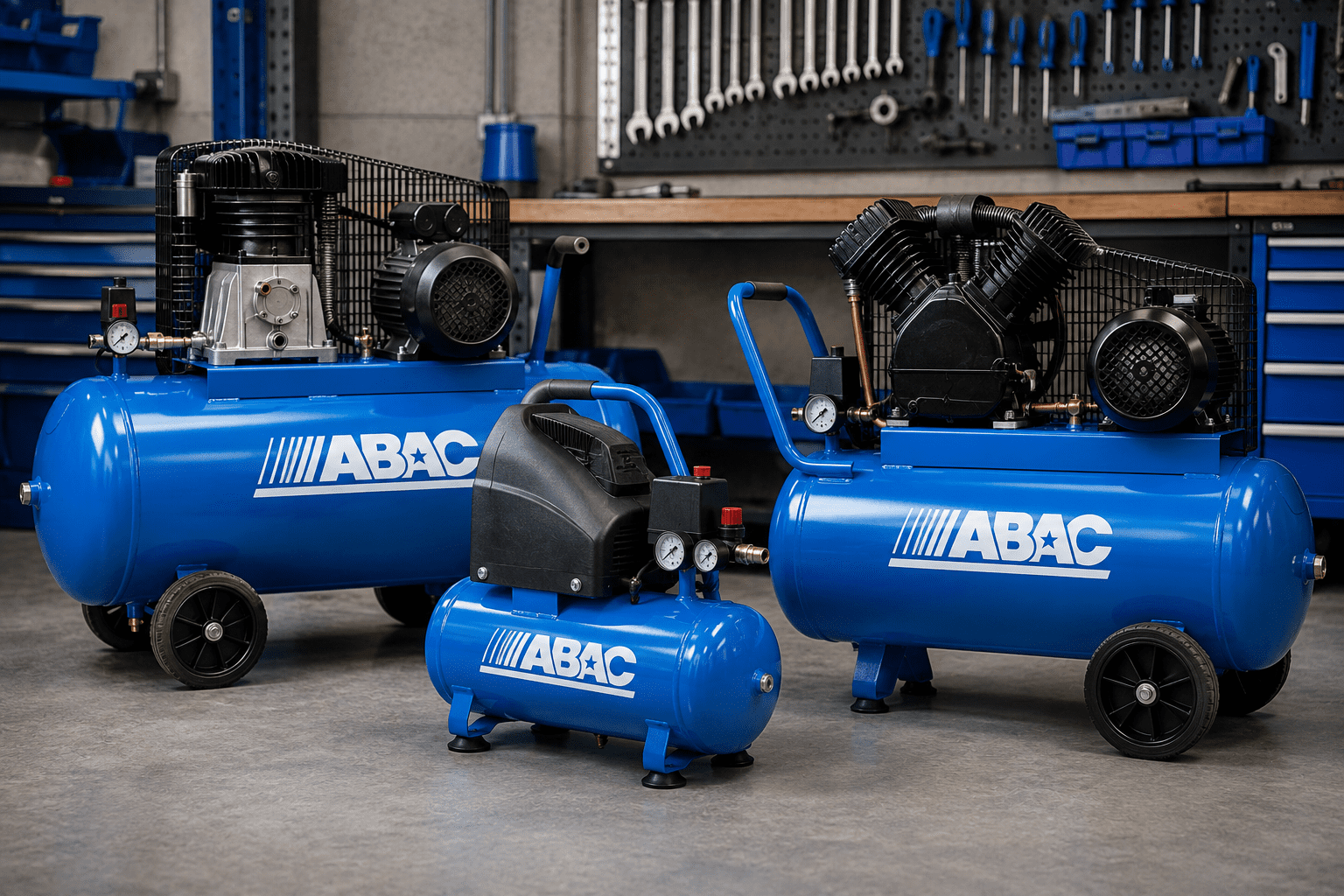
Compressed air is one of the most versatile sources of power in a workshop, garage or engineering environment, but selecting the right compressor is essential if tools and equipment are expected to perform reliably. ABAC piston air compressors provide a broad range of compressed-air solutions covering everything from compact direct-drive compressors through to larger belt-driven and two-stage machines designed for more demanding professional applications. ABAC's current piston portfolio spans direct-drive, belt-driven, specialist and professional single and two-stage compressor designs, giving businesses considerable flexibility when matching a compressor to their actual air demand.
The ABAC Piston Compressors range at Orion Air Sales brings together a particularly extensive selection. The current category contains well over 100 products and includes direct-drive machines, belt-driven compressors, compressor pumps, receiver-mounted systems and petrol or diesel engine-driven models, alongside more specialised ABAC compressed-air equipment.
What Is an ABAC Piston Air Compressor?
A piston air compressor, sometimes called a reciprocating compressor, produces compressed air using a piston moving within a cylinder. During operation, atmospheric air is drawn into the compressor, compressed and then delivered to an air receiver or compressed-air system. The stored compressed air can subsequently be used by pneumatic tools, machinery and other equipment.
Piston compressors are particularly useful where compressed-air demand is intermittent or varies considerably throughout the working day. This makes them a familiar sight in garages, workshops, maintenance departments, fabrication businesses and many other professional environments.
The broad ABAC piston range means that the same fundamental compressor technology can be configured for very different applications. ABAC offers compact mobile direct-drive compressors at one end of its range and larger professional two-stage belt-driven compressors at the other. ABAC states that its piston portfolio extends from approximately 0.6 kW to 18.5 kW.
Why Choose an ABAC Piston Compressor?
The advantage of such a broad range is that businesses don't need to approach piston compressors as a one-size-fits-all product. A mobile compressor used occasionally with a nail gun has very different requirements from a workshop supplying several pneumatic tools, and both are different again from a professional facility requiring higher pressure or greater air delivery.
ABAC's direct-drive range is designed to cover applications extending from DIY and occasional use through to professional operation, while its professional belt-driven ranges are intended for more demanding workshop applications. This allows users to select equipment according to factors such as required airflow, operating pressure, receiver capacity, electrical supply, mobility and expected frequency of use.
The important part is choosing the compressor according to the air requirement of the application, rather than simply purchasing according to horsepower or receiver size.
Direct-Drive ABAC Piston Air Compressors
A direct-drive piston compressor connects the motor directly to the compressor pump rather than transferring power through a belt arrangement. This can create a compact and straightforward compressor package and is particularly useful where portability and convenient operation are priorities.
ABAC positions its direct-drive compressor family across applications ranging from occasional and hobby use through to professional daily operation. Its range also includes mobile models and specialist clean-air configurations. For smaller workshops, maintenance applications, mobile technicians and users with intermittent compressed-air requirements, a direct-drive compressor can therefore provide an attractive solution.
The Orion range currently includes direct-drive ABAC equipment such as 50-litre 2 HP models alongside larger professional direct-drive configurations, demonstrating how the technology isn't limited to one particular type of user.
Belt-Driven ABAC Piston Air Compressors
For businesses with more demanding compressed-air requirements, ABAC belt-drive air compressors provide another important option. Instead of connecting the motor directly to the compressor pump, power is transmitted through a belt-drive arrangement.
ABAC offers an extensive selection of professional belt-driven compressors, and the Orion range includes numerous receiver capacities and power configurations. Current examples include ABAC EXP and Expert machines with receivers ranging through 50, 90, 150, 200 and 270 litres, as well as larger industrial configurations.
These machines can be particularly suitable for professional workshops, engineering environments and businesses requiring compressed air more frequently than an occasional-use compressor would typically be expected to provide.
Single-Stage and Two-Stage Piston Compressors
One of the important distinctions when selecting a professional piston compressor is whether the machine uses single-stage or two-stage compression.
In a two-stage compressor, air undergoes an initial stage of compression before passing through an intercooling stage and then undergoing a second compression stage to reach its final pressure. ABAC describes its two-stage belt-drive machines as being aimed at professional users requiring higher performance and more frequent compressed-air supply, including medium and large workshops.
This makes ABAC two-stage piston compressors particularly interesting for more demanding professional applications where greater airflow, higher pressure or more intensive operation is required. However, two-stage shouldn't automatically be interpreted as "better" for every application. The correct choice depends on the required pressure, airflow, operating pattern and equipment being supplied.
Understanding Airflow When Choosing an Air Compressor
Airflow is one of the most important specifications when choosing an air compressor. Pneumatic tools consume compressed air at different rates, and a compressor needs to provide enough usable air to satisfy the equipment operating from it. If several tools may operate simultaneously, their combined demand also needs to be considered.
This is why choosing an air compressor solely by receiver size can be misleading. A large receiver provides additional stored compressed air, but it doesn't change the underlying amount of air the compressor pump can produce over time. When comparing ABAC piston compressors, buyers should therefore consider the compressor's stated air-delivery figures alongside the requirements of the tools and machinery they intend to operate.
For professional installations, an allowance for future expansion can also be worthwhile. A compressor selected precisely for today's requirement may become restrictive if another workstation or pneumatic tool is added later.
What Does the Air Receiver Do?
Many piston compressors are mounted on an air receiver, commonly referred to as the compressor tank. Receiver capacities vary considerably throughout the ABAC range, with the current Orion selection including compact units as well as professional machines using substantially larger receivers. The receiver stores compressed air and provides a buffer between the compressor and changing downstream demand. This stored volume can be particularly useful when a pneumatic tool briefly requires more air than the compressor itself is producing at that instant.
However, a bigger air receiver doesn't automatically mean a more powerful compressor. Pump output, pressure capability, motor power and duty requirements remain important. The receiver should therefore be considered as one part of the complete compressor system rather than the specification used to choose the machine.
230V or 400V ABAC Air Compressor?
Electrical supply is another important consideration. The Orion ABAC piston-compressor range includes both 230V single-phase and 400V three-phase configurations. For example, the current range contains professional belt-driven compressors in 230V configurations alongside numerous industrial 400V models.
230V equipment can be convenient for smaller workshops and premises without a three-phase electrical supply. Larger professional compressors are frequently available with 400V three-phase motors where the site has a suitable electrical installation.
Before purchasing a compressor, the available electrical supply should always be checked against the exact machine specification. Larger compressors can also have specific starting-current and electrical installation requirements, so the electrical supply and protection should be assessed appropriately.
ABAC Compressors for Garages and Automotive Workshops
Vehicle workshops are one of the classic applications for piston air compressors. Compressed air may be required for tyre inflation, blow guns, pneumatic impact tools, air ratchets and various workshop operations. However, not every automotive workshop has the same demand. A small independent garage where air tools are used intermittently might have very different requirements from a larger workshop containing several technicians working simultaneously.
For this reason, an ABAC air compressor for a garage should be selected according to the combined airflow requirement of the equipment likely to operate at the same time, together with the desired operating pressure and frequency of use.
Receiver capacity, available electrical supply, compressor location and future workshop expansion should also form part of the decision.
ABAC Compressors for Engineering and Manufacturing
Piston compressors can also provide compressed air for engineering, manufacturing and maintenance applications where demand is appropriate for reciprocating compressor technology. Air can be used for pneumatic tools, component cleaning, machinery, maintenance operations, assembly work and numerous other industrial processes.
For more demanding applications, ABAC's professional two-stage range is specifically positioned towards medium and large workshops, professional users and OEM applications requiring heavier-duty and more frequent compressed air.
As demand increases, however, it becomes increasingly important to consider the complete compressed-air requirement rather than simply buying a larger piston compressor. Where a facility has substantial continuous demand, alternative compressor technologies may deserve consideration.
Portable and Engine-Driven ABAC Piston Compressors
Not every compressed-air requirement occurs next to a convenient electrical socket. The Orion ABAC range also includes petrol and diesel engine-driven piston air compressors, providing options for mobile applications, outdoor work and locations where mains electricity may not be readily available. Current models include petrol-powered configurations with different receiver sizes as well as diesel-powered equipment.
Engine-driven compressors can be useful for appropriate construction, maintenance, agricultural and mobile service applications.
As with electrically powered compressors, the machine needs to be selected according to airflow, pressure and duty requirements. Engine-driven equipment also requires appropriate operating conditions and must be used in accordance with the manufacturer's safety and ventilation requirements.
Oil-Lubricated or Oil-Free Compressed Air?
Another important consideration is the required quality of the compressed air. Traditional oil-lubricated piston compressors are suitable for a very wide range of workshop and industrial applications, particularly where small quantities of lubricant carried within the compressed-air system can be appropriately managed through downstream air treatment.
Some applications have much more stringent air-quality requirements. ABAC therefore also produces oil-free compressed-air solutions within its broader compressor portfolio. Users shouldn't assume that "oil-free" and "oil-lubricated" are interchangeable descriptions. The required compressed-air quality depends on the process, equipment and relevant standards or specifications.
Where air quality is critical, the entire system—including compressor technology, filtration, dryers and downstream treatment—needs to be considered.
Why Compressed-Air Treatment Matters
Producing compressed air is only the first part of a complete compressed-air system. Compressing atmospheric air can result in moisture becoming a significant consideration within the system. Depending on the application, downstream equipment can include filters, water separators and compressed-air dryers.
The appropriate level of air treatment depends on what the compressed air will be used for. A basic workshop blow gun has very different air-quality requirements from sensitive instrumentation or a process requiring particularly clean, dry compressed air.
Businesses should therefore consider the compressor and air-treatment system together rather than viewing them as unrelated purchases.
Choosing an ABAC Piston Compressor for Air Tools
The best way to select a compressor for pneumatic tools is to start with the tools rather than the compressor. Identify the required operating pressure and air consumption of each tool, determine which tools are likely to operate simultaneously and then establish the likely peak and typical compressed-air demand. A compressor can then be selected with suitable output and sensible capacity in reserve.
This approach is much more reliable than selecting a compressor simply because it has a large receiver or high horsepower rating.
For example, an intermittently used nail gun and a continuously operating air-powered process can have completely different requirements even if both operate from compressed air.
Piston Compressor or Rotary Screw Compressor?
This is another useful question for professional buyers. A piston compressor can be an excellent solution where demand is intermittent, variable or associated with workshop tools and general professional applications. They are available in numerous sizes and can provide a relatively straightforward compressed-air solution. A rotary screw compressor is commonly considered where a business has higher and more continuous compressed-air demand over extended periods.
There isn't a universal point at which one technology automatically becomes correct. Operating hours, airflow requirement, pressure, duty cycle, energy use, noise, maintenance and future expansion should all influence the decision. A workshop that only requires compressed air periodically may have little reason to install a compressor designed around continuous industrial demand. Conversely, a production facility operating pneumatic machinery throughout the working day shouldn't automatically assume that a larger receiver will turn an intermittently rated piston machine into the appropriate solution.
What Industries Use ABAC Piston Compressors?
The flexibility of piston-compressor technology makes it suitable for a broad range of applications when the compressor is correctly selected.
| Application | Typical Compressed-Air Uses |
|---|---|
| Automotive Garages | Tyre inflation, blow guns and pneumatic workshop tools |
| Engineering Workshops | Air tools, cleaning, maintenance and assembly |
| Fabrication Workshops | Pneumatic equipment and general workshop compressed air |
| Manufacturing | Appropriate intermittent production and maintenance duties |
| Joinery Workshops | Nailing, stapling, cleaning and pneumatic equipment |
| Maintenance Departments | General air tools and equipment servicing |
| Agricultural Workshops | Machinery maintenance and inflation duties |
| Mobile Service Engineers | Portable compressed air where appropriate |
| Construction & Site Work | Pneumatic equipment and mobile compressed-air requirements |
| Tyre Shops | Inflation and appropriate pneumatic tools |
| Bodyshops | Pneumatic tools and suitably treated compressed-air applications |
| DIY & Home Workshops | Occasional inflation, cleaning and tool operation |
| OEM Equipment | Integrated compressed-air applications where correctly specified |
How Do I Choose the Right ABAC Piston Air Compressor?
Start by determining how much compressed air you actually need. List the pneumatic tools, machinery and processes that will use compressed air. Check their required airflow and pressure, then consider how many could operate simultaneously. From there, consider operating hours, duty pattern, receiver capacity, electrical supply, air quality, noise, installation location and future expansion.
For smaller and more intermittent applications, a compact direct-drive ABAC compressor may provide everything required. ABAC specifically offers direct-drive ranges extending from hobby and occasional use into professional applications. For workshops requiring more frequent compressed air, a professional belt-driven machine may be more appropriate. For heavier-duty requirements, ABAC's two-stage belt-driven compressors provide another level of capability. The key principle is simple: choose the compressor around the job, not the job around the compressor.
Why Compressor Duty Cycle Matters
A compressor's duty requirements are particularly important when comparing machines for professional use. Some compressed-air applications involve short bursts of demand followed by substantial periods where no air is required. Others need compressed air repeatedly throughout the working day. Those two situations can require very different equipment. If a compressor is routinely expected to operate beyond the conditions for which it was designed, reliability and service life can be affected. Buyers should therefore consider how frequently the compressor will operate as well as its headline airflow and pressure figures.
Where compressed-air demand becomes substantial or continuous, it can be worth comparing piston technology with a suitably sized rotary screw compressor.
Don't Forget the Compressed-Air Pipework
A good compressor can still produce disappointing results if the distribution system is poorly designed. Undersized pipework, excessive lengths, unnecessary restrictions and leaks can create pressure losses and waste compressed air. Larger workshops should therefore consider the compressor, receiver, air treatment and distribution network as one complete system.
This becomes particularly important when several workstations need compressed air simultaneously or when equipment is positioned a significant distance from the compressor.
Allowing for future connections when designing the compressed-air distribution network can also make subsequent workshop expansion considerably easier.
ABAC Piston Compressors from Orion Air Sales
Orion Air Sales offers an extensive range of ABAC piston air compressors for professional, workshop and industrial applications, including direct-drive machines, belt-driven compressors, professional receiver-mounted packages, compressor pumps and engine-driven configurations. The current ABAC piston category contains more than 100 listed products, providing options across a wide variety of compressed-air requirements.
The range includes compact equipment for lighter requirements alongside substantial professional machines for workshops and industrial users. Buyers can compare receiver capacity, motor power, operating pressure, electrical supply and compressor configuration to find equipment appropriate for their application. View the ABAC Piston Air Compressor range at Orion Air Sales
Choosing Compressed Air for the Job You Actually Do
There is no single "best" ABAC piston compressor because compressed-air requirements vary enormously.
For one user, the ideal compressor may be a compact direct-drive unit that can be moved around a workshop. Another business may require a 200 or 270-litre professional belt-driven compressor. A larger engineering facility might require a two-stage machine or need to consider whether a rotary screw compressor would better match its operating pattern.
The best purchasing decision starts with airflow, pressure and usage, followed by receiver capacity, electrical supply, air quality, noise, installation requirements and future demand.
ABAC's broad piston-compressor portfolio makes it possible to match those requirements with equipment ranging from compact mobile units to considerably larger professional systems.
Frequently Asked Questions About ABAC Piston Air Compressors
Are ABAC piston compressors suitable for professional workshops? Yes. ABAC manufactures piston compressors specifically aimed at professional users, including belt-driven and two-stage ranges for medium and larger workshop applications.
What is the difference between direct-drive and belt-driven air compressors? A direct-drive compressor connects the motor directly to the compressor pump, producing a relatively compact arrangement. Belt-driven compressors transfer motor power through a belt system and are widely used in professional piston-compressor configurations. ABAC offers both technologies.
Is a bigger air receiver always better? No. Receiver capacity determines the amount of stored compressed air available, but compressor output, pressure and duty requirements remain critical. A large receiver cannot compensate indefinitely for a compressor that produces less air than the equipment consumes.
Should I choose a 230V or 400V ABAC compressor? This depends on the required compressor and the electrical supply available at the premises. Orion's current ABAC range includes both 230V and 400V piston-compressor configurations.
What size air compressor do I need for a garage? Calculate the airflow and operating-pressure requirements of the tools that may run simultaneously, then select a compressor capable of meeting that demand with suitable reserve capacity. Receiver size, operating pattern and electrical supply should also be considered.
Are ABAC piston compressors suitable for continuous use? This depends on the exact compressor and its specified duty. Piston compressors are often particularly well suited to intermittent and variable demand. Applications requiring high continuous airflow may justify considering other compressor technologies.
What is a two-stage piston compressor? A two-stage machine compresses the air in an initial stage, cools it between stages and then compresses it again to its final pressure. ABAC offers two-stage belt-driven compressors aimed at heavier professional requirements.
Can ABAC compressors be used where mains electricity isn't available? ABAC produces engine-driven compressor configurations, and Orion's current range includes petrol and diesel models for suitable mobile and off-grid applications.
Do I need an air dryer with a piston compressor? Not every application requires the same air treatment. The requirement depends on the acceptable moisture and air-quality level for the tools, machinery or process being supplied. Where dry compressed air is important, a suitable dryer and filtration arrangement may be required.
Are oil-free compressors better than lubricated compressors? Neither technology is universally better. The correct choice depends on the application, required air quality, operating conditions and maintenance requirements.